
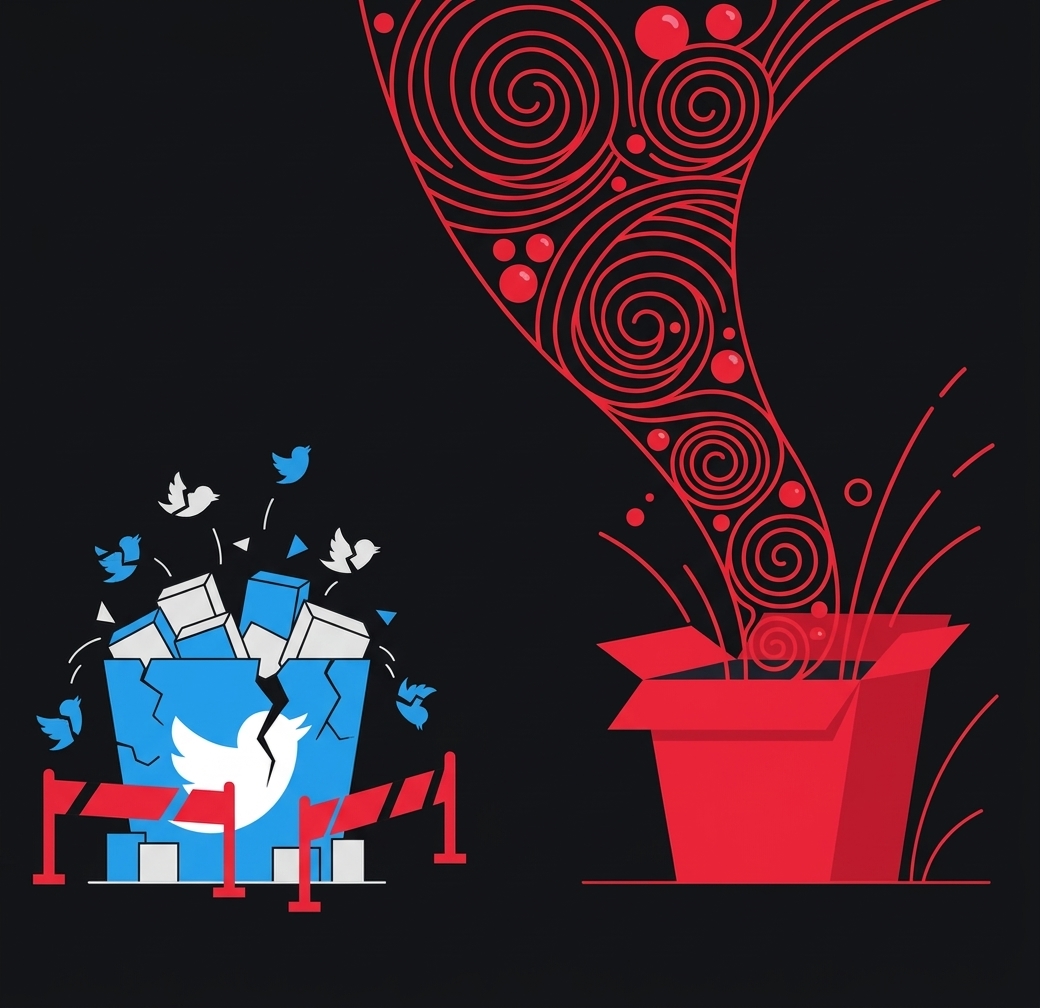
In recent weeks, social media has witnessed interesting events that revealed different strategies in load management. Twitter, one of the largest text-based social networks with approximately 250 million daily active users, began restricting user access in early July, limiting the number of tweets displayed, and subsequently preventing further use for the day.
This throttling lasted for several days and affected many users, including those without paid accounts. Even after quietly lifting the initial limits, further restrictions were introduced, such as preventing logged-out users from viewing tweets. This meant Twitter could no longer serve as a platform for public announcements that anyone could read.
The exact cause of these measures remains unclear, but everything points to infrastructure problems. Twitter operates its infrastructure in its own data centers, but for machine learning (ML) and artificial intelligence (AI) tasks, which are crucial for detecting bots and spam accounts, it utilized Google Cloud services.
Several days after introducing the limits, Twitter officially stated that it had restricted usage to detect and eliminate bots and other malicious actors. According to information from Twitter engineers, this throttling occurred the day after the contract with Google Cloud expired. It is speculated that Twitter, aiming to reduce costs, either stopped paying invoices or negotiated significantly lower quotas, which could have led to the loss of critical tools for reliable detection of malicious activities.

Brauchen Sie Hilfe mit Ihrer Website oder App?
Melden Sie sich, und ich antworte innerhalb von 24 Stunden mit einem Vorschlag für das weitere Vorgehen.
Twitter's decision to address the problem by reducing user interaction likely led to a loss of advertising revenue. The entire situation clearly demonstrates how challenging it is to reliably operate a large social network when the primary goal is cost savings at the expense of operational stability and user experience.
In contrast, Instagram Threads, Meta's new text-based social network, experienced a completely different launch. It was launched without any restrictions and achieved enormous success: within the first seven hours, it reached 10 million registrations, and within the first 24 hours, it surpassed the 30 million user mark.
Onboarding 30 million new users in less than a day without any throttling is an impressive feat for any social network. This was primarily possible due to two key factors. Firstly, Threads' infrastructure was ready for massive scaling from day one. The Threads team could leverage Instagram's robust infrastructure, which serves over a billion active users monthly. Secondly, the platform had access to advanced moderation tools and mechanisms for managing network dynamics that Meta developed for Facebook and Instagram. This includes both user self-moderation tools (blocking, muting) and platform-level content moderation.
In comparison, another text-based network, Bluesky, launched its app in February 2023 and gained 180,000 users in four months, with millions more waiting for an invite. Bluesky had to manage user onboarding to keep up with infrastructure scaling and moderation tool development, which highlights the scale of Threads' success.
The only minor flaw in Threads' launch was the app's unavailability in the European Union. This restriction is likely due to complications with full compatibility with GDPR regulations, such as the necessity to delete an Instagram account to delete a Threads profile.
Although Threads faces challenges with GDPR, it is clear that its strategy focuses on rapid growth and is not limited by infrastructure cost concerns. In contrast, Twitter is focused on cost optimization, even at the expense of reduced user engagement and potentially lower growth. The coming months will show how these two distinct strategies will play out in the long term within the competitive social media landscape.