
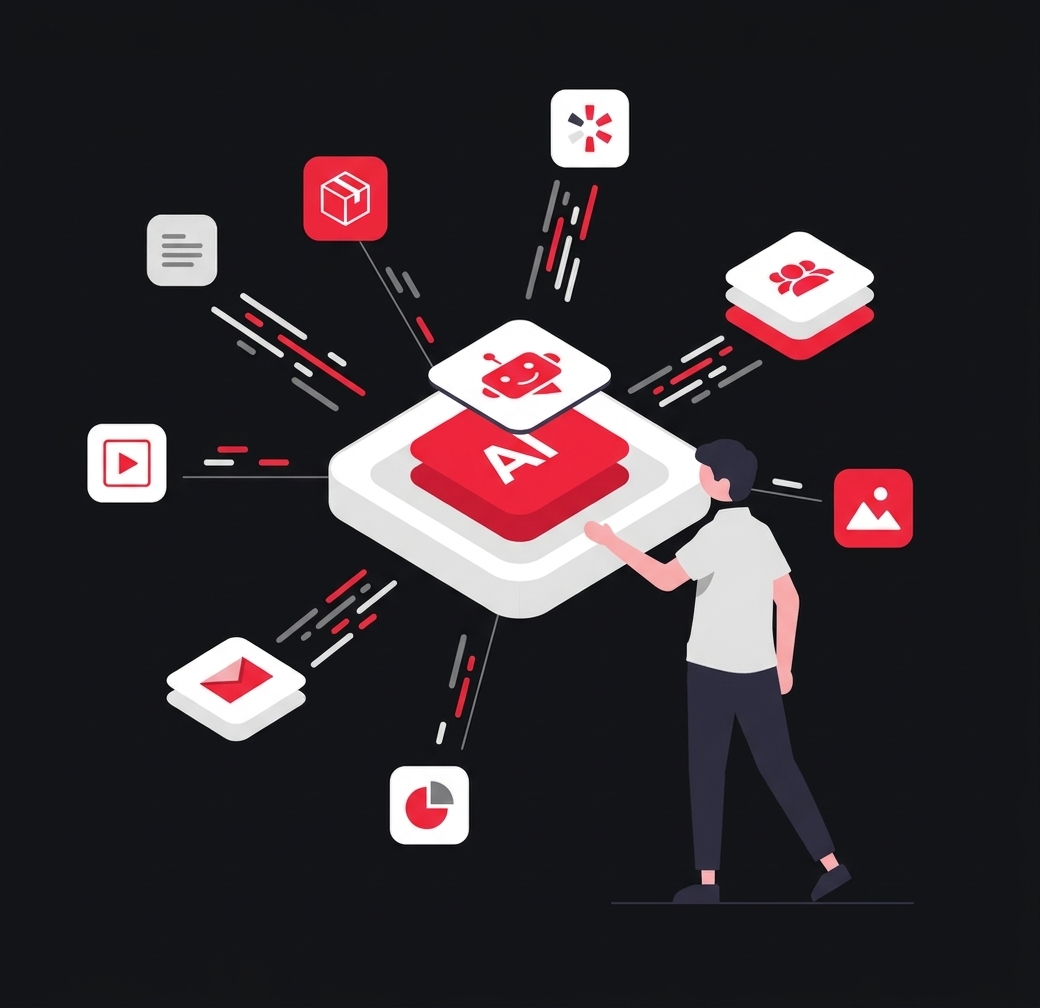
While OpenAI's recent developer conference primarily showcased new AI models and autonomous agents, known as “Dots,” the summary of announced functionalities points to a much broader strategy: an intention to disrupt the established model of software distribution platforms. This entire initiative aims to make the chat interface the primary place where both users and AI agents can discover, launch, and effectively utilize various applications.
Concurrently, the ability for users to leverage their chat interface identity in third-party applications was introduced, further allowing them to transfer their existing AI feature usage credit to these external services.
While this isn't the first experiment with integrating applications into a chat environment, the current vision appears significantly more sophisticated. The company is transforming the chat interface itself into an application launching platform. This service, boasting a massive user base, has not yet fully leveraged its potential as a mechanism for discovering and utilizing applications that synergistically work with artificial intelligence.
The system will now be able to dynamically suggest relevant applications directly during a conversation, once it recognizes that a specific tool could help the user complete a task. Users will then be able to connect the application and start using it directly within the chat interface.
This functionality is significantly supported by an expanded plugin architecture, which now also includes so-called “extensions.” This allows developers to create interactive panels, enabling users to work with their tools directly during a conversation with artificial intelligence. This essentially brings applications and services that users previously accessed via a web browser, desktop, or mobile app into an environment controlled directly from the chat interface.
Developers who join this system can thus create AI-optimized versions of their applications, just as they would develop them for the open web or traditional mobile app stores. Given the growing importance of AI chat as a software discovery tool, this represents a distribution channel that is difficult for many creators to ignore.
A recent demonstration showed how an integrated meeting management application can function within the chat interface, displaying upcoming events from the user's calendar. Users could easily leverage AI to take meeting notes and subsequently receive a summary of action items after it concluded. Another example showcased interaction with design applications, such as those from well-known creators, where users could perform project revisions or utilize specific features that would otherwise require launching a separate application.
Furthermore, these integrated applications can be easily shared with colleagues via lightweight web pages generated by the chat interface. From these pages, collaborators can log into the application with their own credentials and permissions, ensuring a personalized software experience.
Important changes also concern the plugin approval process, which is analogous to app review on traditional distribution platforms. Developers will now have the ability to track their approval status, identify necessary adjustments, request manual review, and update their plugin tools without having to restart the entire submission process.
The company also introduced a new application marketplace for enterprise customers, where partners can offer their services. At launch, more than 30 partners presented their applications on this marketplace. Eligible customers can also apply a portion of their OpenAI commitments towards approved partner software.

Planen Sie eine neue Website oder App?
Schreiben Sie mir, was Sie vorhaben — ich schaue es mir gerne an und berate Sie zum besten Vorgehen.
Beyond transforming the chat interface into an application discovery tool, the involvement of AI agents is ushering users into a new era where they no longer have to deliberate as much about which application to use, but rather rely on the suggestions of their intelligent agents. With the introduction of autonomous AI agents, designated as “Dots,” these agents autonomously navigate the web and execute necessary tasks within their own cloud infrastructure. Each such agent possesses its own cloud computer and browser and is capable of utilizing connected applications. Unlike the older model, where users had to download various applications to their computer or phone for project management (e.g., website creation or meeting calendar coordination), now it's enough to tell the intelligent agent the desired outcome, and it simply performs it for them. In some cases, the agent's work may require access to another AI model or a specific application, but the agent then brings this functionality to the user, instead of the user actively searching for a specific tool for the given task.
Furthermore, these agents can be proactive, for example, offering help with a project, assisting with error resolution, or taking care of a forgotten task—always, however, with the user's explicit consent. The agent performs so-called “proactive research” in the background, utilizing connected applications in read-only mode, while users still maintain full control over its actions.
This system could provide application creators with another path to customers outside traditional app stores. For example, users could subscribe to a service directly on the developer's website and then link that account to the chat interface for agent use. However, OpenAI has not yet confirmed that these features would eliminate the need for separate subscriptions or other third-party fees. The company has so far focused on building discovery, distribution, and interface mechanisms as a counterpoint to the existing app store model, along with an identity layer and AI credit sharing. However, it has not announced plans for a billing or revenue-sharing system that would align with the economic model of traditional app stores.